For Immediate Release:
May 6, 2010
Walking, bicycling a better way to commute
Monmouth County Transportation Summit seeks connectivity
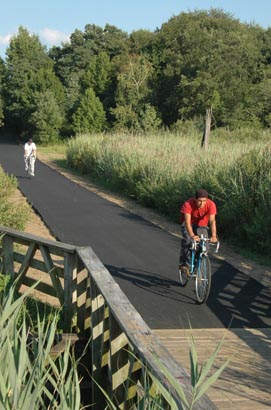
FREEHOLD, NJ – Americans are seeing a decline in the dominance of cars as more and more cities recognize they can no longer afford to expand the massive highway and bridge infrastructure that has accumulated over the last 60 years. Planners are providing for bikers and pedestrians.
“In New Jersey, we are even having difficulty maintaining what is already in place,” said Monmouth County Freeholder John D’Amico, who is Monmouth County’s representative on the North Jersey Transportation Planning Authority (NJTPA). “Under these circumstances, it makes sense, and it is a lot cheaper, to provide for bikers, walkers and transit users.”
D’Amico, who spoke recently at the 7th annual Transportation Summit sponsored by the Monmouth County Transportation Council, said New Jersey is moving in the wrong direction.
“The number of bicycle commuters in New Jersey is approximately 12,000, or only 0.3 percent,” said D’Amico, a longtime transportation advocate. “By way of contrast, 6 percent of Portland, OR residents ride bikes. Only 3.4 percent of New Jerseyans walk to work.”
It’s not surprising, given the fact that New Jersey ranks third to last in per-capita spending of transportation dollars on bicycle and pedestrian projects.
Transportation represents the largest, and fastest-growing segment of New Jersey’s carbon footprint at 35 percent, compared to a national average of 26 percent.
“NJ Transit has just increased its rail fares 25 percent and bus fares by 10 percent, the inevitable effect of which will be to divert more riders to automobiles, leading to increased traffic congestion, higher consumption of imported oil and worsening air pollution,” D’Amico said.
Monmouth County is in a non-attainment area in terms of compliance with national air quality standards for ozone and particulate matter. Riding a bicycle or walking does not produce air pollution or carbon emissions. In recognition of these facts, Monmouth County has been actively pursuing federal funding to implement safety improvements for pedestrians and bicyclists.
At the Transportation Summit, residents and municipal officials got a comprehensive view of the county’s non-motorized transportation network, which includes bicycles and pedestrian facilities.
“In 2009, our Engineering Division applied for funding under the American Recovery and Reinvestment Act (ARRA) for safety improvements in Eatontown, Oceanport and West Long Branch, including sidewalks and ADA upgrades, to connect residential areas along Route 71 and the extensive commercial establishments located at the intersection of Route 71 and Route 36,” D’Amico said.
“Unfortunately, this project did not receive any funding in spite of being the only top priority pedestrian project in the county with strong support from the affected governing bodies.”
This funding opportunity has not been available to counties this year. In February, the Engineering Division applied for $500,000 under the NJTPA’s fiscal year 2011 Local Safety Program for safety improvements along County Route 10 (Front Street and River Road) in Red Bank. This project would include significant pedestrian and vehicular safety improvements along a corridor heavily utilized by various modes of transportation through a vibrant and very successful urban redevelopment zone offering commercial, business and cultural amenities.
“We do not know the final scoring of the applications submitted for this funding source, and we are eagerly awaiting a positive response,” D’Amico said. “These two projects are examples of ways in which we can encourage pedestrian and bicycle transportation at relatively low cost.
D’Amico said there are many other similar opportunities throughout Monmouth County.
“It is my hope that the New Jersey Department of Transportation, NJ Transit, and the NJTPA will reverse the direction of transportation planning in New Jersey and follow the example of enlightened states, counties and cities from coast to coast that are making their communities walkable and bikeable and encouraging their citizens to use public transportation,” D’Amico said.
# # #
Photo caption: The county's Henry Hudson Trail already provides a walk or bike to work option.