For Immediate Release:
December 8, 2008
Blueprint: new green jobs; reductions in energy and GHG emissions
Local Climate Action Week highlights ‘go green’ effort
Freeholders D’Amico, McMorrow echo call for federal stimulus money
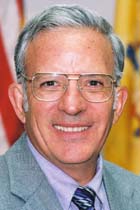
FREEHOLD – Freeholders John D’Amico Jr. and Barbara J. McMorrow have joined local officials throughout the country who are calling on President-elect Barack Obama and the incoming Congress this week to invest stimulus money to fund local government projects that will encourage the creation of new green jobs, revitalize the economy and promote energy independence.
The clarion call for investment in energy saving projects comes at the start of national “Local Climate Action Week” Dec. 8 through Dec. 15, and stems from a Local Government Climate Leaders Retreat in September that brought together 50 of the nation’s top local government leaders to develop a “Blueprint for Local Climate Action.” D’Amico attended that retreat.
“We were pleased that during his campaign, President-elect Obama indicated support for investment in energy saving projects to help create jobs and spur economic recovery,” D’Amico said. “We want President-elect Obama and the Congress to know that with federal assistance we are ready to put hundreds of Monmouth County citizens to work in jobs that ultimately will ease our dependence on foreign oil and achieve significantly reduced greenhouse gas (GHG) emissions.”
Specifically, D’Amico and McMorrow and other local officials nationwide are joining with Climate Communities and ICLEI USA to endorse “Empowering Local Government Climate Action: Blueprint for President Obama and 111th Congress.” ICLEI USA is an association of local governments that is helping communities measure their carbon footprint and implement local climate action plans to reduce energy consumption. The goal is to ensure that federal policies empower local communities with the tools and resources needed to get the job done.
.jpg)
“Supporting local government action should be a top priority as Washington develops new economic stimulus, climate and energy policies,” McMorrow said. “With federal assistance we are ready to put the President-elect’s plans into action.
Increasingly, economists are promoting green jobs as key to the nation’s economic recovery and long-term growth. Three coastal communities – Asbury Park, Bradley Beach and Neptune Township – are investigating large-scale solar projects that would create many jobs and keep energy costs stable. These towns have abundant natural sun more than 100 days a year.
Meanwhile, Monmouth County has begun looking at ways to reduce energy and greenhouse gas emissions at county facilities, and continues to be at the leading edge of technologies that promote renewable energy and cost savings at the Reclamation Center in Tinton Falls, including:
-
A gas-to-energy program that harnesses methane gas produced naturally by decomposing garbage and converts it into electricity – enough to power some 10,000 homes as well as the landfill’s Materials Processing and Recovery Facility, providing steady income and saving the county in what it would cost to buy electricity fro
-
A recycling program that developed a productive use for broken, mixed-colored glass. The county uses the otherwise unmarketable glass and pulverizes it into a sand-like aggregate product that the county uses with the landfill’s protective liner and drainage system as well as supplementing our daily cover needs. The county saves about $25,000 a month for its operational budget and reduces the capital expenditure for drainage system construction by about $55,000 per acre.
Additionally, the county Department of Public Works has switched to bio-diesel fuel for the county’s vehicle fleet, and last year the Highway Department stopped using rock salt treated with potentially harmful calcium and instead began using rock salt treated with magnesium chloride, which is biodegradable and does not damage grass and plants. It works better than calcium chloride, too, which means workers spend half the time applying it during a storm.
Local governments across the country are implementing innovative policies and programs to reduce greenhouse gas (GHG) emissions, including promoting so-called “green buildings,” expanding public transit, purchasing hybrid buses, using geothermal energy to heat police and fire stations, and providing incentives to residents to replace old boilers and home energy units.
Local government actions have the potential to dramatically reduce energy consumption and greenhouse gas emissions. According to the Energy Information Administration, more than 40 percent of energy consumption and carbon emissions comes from residential and commercial buildings. And one-third is generated by the transportation sector.
“Local governments set and enforce building codes, determine transportation and land use policies and we are dramatically affected when our communicates suffer untold human and economic loss from floods, wildfires, water shortages and other climate events,” McMorrow said.
McMorrow and D’Amico have spent this past year gathering and presenting information about ways in which local governments can “go green” through a series of environmental luncheons. The luncheons have been attended by local elected officials and their department heads.
In an effort to explore ways in which Monmouth County can lessen its carbon footprint on the world, the Board of Chosen Freeholders recently directed the Planning Board to create an inventory of the county’s operational GHG emissions and develop a plan to implement policies, programs and operations to achieve significant, measurable and sustainable reductions of those emissions.
“Counties will play a very important role in reducing energy and greenhouse gas emissions because of their regional perspective in transportation planning, water conservation and wastewater and solid waste management,” D’Amico said. “Monmouth County is addressing these important issues and taking steps to promote energy efficiency.”
Currently, there are no federal programs to support local climate and energy initiatives. The Local Government Climate Action Blueprint calls for stimulus legislation to include $10 billion for the Energy Efficiency and Conservation Block Grant program and $18 billion for public transit and green vehicle infrastructure. The blueprint outlines many other opportunities for the federal government to invest in local government innovation, including:
- Enactment of a national GHG cap-and-trade program with some of the estimated $150 billion carbon trading revenues invested in local government climate action and green jobs initiatives;
- Investment in public transit, green vehicles and vehicle miles traveled (VMT) reduction through reauthorization of $400 billion federal transportation legislation; and
- $250 million for EPA Local Climate Demonstration Grants that empower local governments to continue creating new solutions to the climate challenge.
Addressing climate change will help the United States achieve energy independence and improve national security; create new jobs and business opportunities, and preserve the planet for future generations. The Blueprint for Local Climate Action seeks national recognition of the essential role local governments play in addressing climate change, and advocates for a strong local and federal partnership that provides resources and assistance to empower local communities to act.
“Local governments have laid the foundation for this country’s response to global climate change, providing the leadership, solutions and innovation that city by county by town have helped curb greenhouse gas emissions and reduce energy use and costs,” McMorrow said. “Monmouth County is already actively pursuing projects that will further reduce energy and emissions.”
“The economic arguments for implementing climate stabilization solutions are compelling, from near-term gains of energy efficiency to long-term climate protection initiatives,” D’Amico said. “With support and assistance from the federal government, municipal and county governments will have the power to effectively combat climate change and reduce our dependence on foreign oil.”
“Local governments are uniquely positioned to implement economic development strategies that create green business and green jobs that can transform the American economy,” he added.
# # #
* An overview of the Blueprint for Local Action is attached below
The Blueprint for Local Climate Action
In September, a historic climate action meeting last week that brought together 50 of the nation’s top local government leaders to develop a “Blueprint for Local Climate Action” that will be forwarded to the next President of the United States.
The Local Government Climate Leaders Retreat was sponsored by Climate Communities, a coalition of local governments that is advocating for federal support for local climate change action, and ICLEI USA, an association of local governments that helps communities measure their carbon footprint and implement local climate action plans to reduce energy consumption.
With support from the Rockefeller Brothers Fund, the meeting was held Sept. 14 to 16 at the Pocantico Center of the Rockefeller estate near Tarrytown, New York.
The Blueprint for Local Climate Action recommends the following: Enact a national climate policy that:
• Sets mandatory limits on greenhouse gas emissions with market-based trading;
• Invests the proceeds from carbon trading into local government actions that reduce emissions through green buildings; transit, smart growth and other VMT reduction strategies; green local fleets and fuels; renewable energy; green infrastructure; and green jobs and businesses; and
• Allows regulated emitters to invest through carbon off sets in local green infrastructure that reduces greenhouse gases, including community forestry, green roofs, and open space and farmland preservation.
Enact an economic recovery policy that creates green jobs by:
• Providing $10 billion in Energy Efficiency and Conservation Block Grants for local governments; and
• Providing $18 billion for local transit infrastructure projects.
Implement clean energy policies that:
• Reduce building energy use by 30 percent by 2025 by establishing national building efficiency targets and providing annual funding to help local governments meet or exceed the national targets; and
• Produce 25 percent of the nation’s power from renewable energy by 2025 through renewable portfolio standards, and measures to overcome interconnection and rate barriers to community-scale renewables.
Invest in local climate capacity through annual federal appropriations that:
• Fully fund the Energy Efficiency and Conservation Block Grants at $2 billion annually;
• Provide $250 million annually for EPA Local Climate Demonstration Grants;
• Provide $400 million annually for the DOE Clean Cities program to support low emission vehicles and cleaner fuels including alternative fuels infrastructure and plug-in hybrid vehicles; and
• Provide $100 million annually for the Forest Service’s Urban and Community Forestry program.
Transform the nation’s transportation strategy by:
• Substantially increasing federal resources for public transit;
• Supporting local initiatives to reduce vehicle-dependence and use including resources for smart growth and transit-oriented development, VMT reduction planning and implementation, walkability programs, bikeways and greenways, infill and brown fields revitalization, and reuse of historic and existing buildings; and
• Funding low-emission busses, clean local fleets, and local alternative fuels infrastructure.
Create American green jobs and green businesses by:
• Creating a $500 million “Climate Prosperity” demonstration grant program that directs Economic Development Administration, HUD, Small Business Administration, and USDA Rural Development funding to support local economic development strategies that produce green businesses and jobs;
• Fully funding the Green Jobs Act of 2007 at $125 million annually to support worker training in emerging manufacturing and hi-tech sectors; and
• Creating an “Energy Conservation Corps” service program to empower young Americans to be part of new clean energy solutions.
Build self-reliant communities that are prepared for climate impacts by:
• Creating a federal interagency task force on Climate Resiliency and Community Preparedness to produce a federal action plan for (a) national research and development; (b) local technical assistance; and (c) new protocols for intergovernmental collaboration at local, state, regional and federal levels;
• Expanding the FEMA Pre-Disaster Mitigation program to $500 million annually to support local government initiatives to address climate impacts;
• Expanding NOAA’s Coastal Zone Management Act and climate programs to directly support local climate adaptation planning and implementation; and
• Fostering and funding local efforts to support families and populations most vulnerable to climate impacts.