Freeholder D’Amico attends national climate meeting
Blueprint for action will be given to next U.S. president
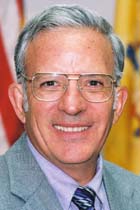 FREEHOLD – Freeholder John D’Amico participated in a historic climate action meeting last week that brought together 50 of the nation’s top local government leaders to develop a “Blueprint for Local Climate Action” that will be forwarded to the next President of the United States.
The Local Government Climate Leaders Retreat was sponsored by Climate Communities, a coalition of local governments that is advocating for federal support for local climate change action, and ICLEI USA, an association of local governments that is helping communities measure their carbon footprint and implement local climate action plans to reduce energy consumption.
With support from the Rockefeller Brothers Fund, the meeting was held Sept. 14 to 16 at the Pocantico Center of the Rockefeller estate near Tarrytown, New York.
“I was honored to be selected by the Climate Communities and ICLEI USA to participate in the Local Government Climate Leaders Retreat,” D’Amico said. “Mayors, county commissioners and environmental officials from all over the country identified opportunities to collaborate in addressing local and federal climate change issues. I am pleased to be able to represent Monmouth County and New Jersey in this important effort.”
Local governments across the country are implementing innovative policies and programs to reduce greenhouse gas (GHG) emissions, including promoting so-called “green buildings,” expanding public transit, purchasing hybrid buses, using geothermal energy to heat police and fire stations, and providing incentives to residents to replace old boilers and home energy units.
In an effort to explore ways in which Monmouth County can lessen its carbon footprint on the world, the Board of Chosen Freeholders recently directed the Planning Board to create an inventory of the county’s operational GHG emissions and develop a plan to implement policies, programs and operations to achieve significant, measurable and sustainable reductions of those emissions.
“Counties can play a unique role in reducing greenhouse gas emissions because of their regional perspective in transportation planning, water conservation and wastewater and solid waste management,” D’Amico said. “This is a very significant step for Monmouth County.”
Addressing climate change will help the United States achieve energy independence and improve national security; create new jobs and business opportunities, and preserve the planet for future generations. The Blueprint for Local Climate Action seeks national recognition of the essential role local governments play in addressing climate change, and advocates for a strong local and federal partnership that provides resources and assistance to empower local communities to act.
“The economic arguments for implementing climate stabilization solutions are compelling, from near-term gains of energy efficiency to long-term climate protection initiatives,” D’Amico said. “With support and assistance from the federal government, municipal and county governments will have the power to effectively combat climate change and reduce our dependence on foreign oil.”
According to the Blueprint for Local Climate Action, more than 40 percent of all GHG emissions comes from commercial and residential buildings, and another third comes from the transportation sector. Local governments and community organizations are the first responders who must deal with the impacts of climate change, including drought, water shortages, wildfires, flooding, rising sea levels and economic shifts and impacts.
“Local governments can promote green infrastructure that reduces carbon emissions, such as open space preservation, waste-to-energy programs and the incorporation of LEED certification in construction,” D’Amico said. “They are uniquely positioned to implement economic development strategies that create green business and green jobs that can transform the American economy>”
The Blueprint for Local Climate Action recommends and supports the following:
• enacting a national cap and investment policy that sets mandatory limits on GHG emissions;
• investing the estimated $150 billion per year in new revenue generated through the carbon market into conservation, sustainable transportation, green technologies and clean energy, and recognizing the essential role of localities in addressing climate change.
• passing a clean energy policy to promote green buildings and renewable energy;
• providing investment in local climate action through annual appropriations;
• creating a world-class transportation system and reducing U.S. dependency on foreign oil by supporting local initiatives that include bikeways and greenways, brownfields revitalization, historic preservation, and funding low-emission buses and alternative fuels;
• Creating jobs by fully funding the Green Jobs Act of 2007 at $125 million per year, and directing Small Business Administration, Housing and Urban Development and other funding to local green business development.
“There is a growing national movement leading our nation to energy independence, a prosperous new economy based on clean energy and green jobs, and preservation of our planet for our children and grandchildren,” D’Amico said. “I am proud to say Monmouth County is addressing these important issues and taking steps to promote energy efficiency.”
# # #